
Where to study across England, Scotland, Wales and Northern Ireland — what each region is known for, and what it costs to live there.
Students routinely spend months comparing league tables and almost no time comparing cities — then discover that rent consumes their budget, or that the nearest employer in their field is three hours away. Location is not a secondary decision.
Use the regional guide below to narrow things down, then let us match specific universities to your subject and grades.
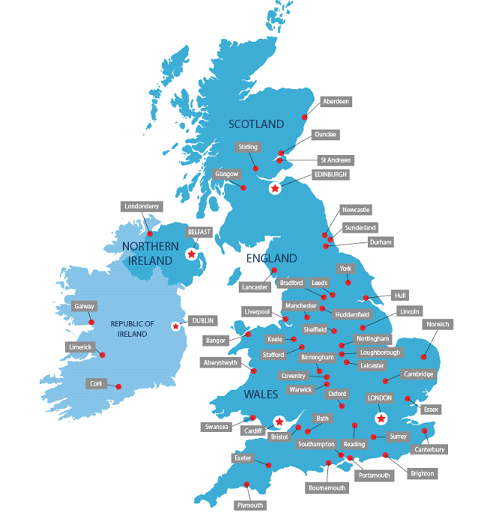
Every region has strong institutions. What differs is cost, scale and which industries sit on the doorstep.
The widest course choice in the UK and unmatched access to finance, law, media and creative employers. Also by far the most expensive place to live — budget carefully, and expect the higher visa maintenance requirement to apply.
Manchester and Liverpool: large, energetic student cities with strong media, engineering and life sciences sectors, at a fraction of London's living costs.
Leeds, Sheffield, York, Newcastle, Bradford and Durham. Excellent value, well-regarded institutions and some of the most affordable student cities in the country.
Birmingham, Nottingham, Coventry, Leicester and Loughborough — a dense cluster of universities with particular strength in engineering, business and sport science.
Oxford, Cambridge, Bristol, Bath, Southampton, Brighton and Canterbury. Historic institutions and strong research, with living costs above the north but below London.
Edinburgh, Glasgow, Aberdeen, Dundee and St Andrews. Four-year honours degrees, outstanding research standing, and moderate living costs.
Cardiff, Swansea, Bangor and Aberystwyth. Among the best value in the UK, with compact campuses and high student satisfaction.
Belfast and Derry. Low living costs, high student satisfaction, and growing technology and health sectors. Part of the UK, so UK immigration rules apply.
Dublin, Cork and Galway. A separate country with its own immigration system — an Irish study visa is required, not a UK Student visa.
Work through these honestly and your list of forty possible universities usually becomes a list of five.
Tuition plus roughly nine months of living costs, for every year of the course. Once you have that number, whole regions either stay on the list or come off it.
Finance and media cluster in London; engineering and manufacturing in the Midlands and north; technology in Dublin, Manchester, Edinburgh and Cambridge. Studying near your industry makes placements far easier.
Neither is better, but they suit different people. Large cities offer anonymity and options; campus towns offer community and lower costs. Be honest about which one you actually want.
Direct flights matter more than students expect, especially in the first year. Check the nearest international airport and what it connects to before committing.
Tell us your course, your budget and what kind of place you want to live in. We will come back with a shortlist that actually fits all three.